
What actually produces bin odor (bacterial breakdown and its volatile compounds), why fragrance in a bag masks rather than fixes it, and the containment habits that work. Your virtual approval process is noted — we understand feedback may come by email within 2 days.
A kitchen bin rarely smells bad the moment food goes into it. The odor builds as microbes get to work. Bacteria naturally present on food, packaging, and the bin itself feed on leftover organic matter. As they break it down, they release gases and other volatile compounds—molecules small enough to evaporate readily and reach your nose.
That is why taking out the trash changes the smell of a room so quickly. You are not just removing the food. You are removing an active, growing source of odor.
What is happening inside the bag?
Different leftovers produce different smells because they contain different materials.
Protein creates some of the strongest odors.
Meat, fish, eggs, dairy, and pet food contain sulfur-bearing amino acids. When microbes break those proteins down, they can produce sulfur compounds such as hydrogen sulfide and methyl mercaptan. These are the rotten-egg and decaying-food notes that seem to cut through everything else.
Protein breakdown can also release ammonia and related nitrogen compounds. Ammonia has the sharp, stinging quality associated with old pet waste, dirty diapers, and forgotten seafood packaging.
Acids and fermentation add sourness.
Fruit, vegetables, coffee grounds, and sugary foods can produce organic acids as they decompose. Acetic acid contributes a vinegar-like smell, while other acids can smell sour, rancid, or vaguely cheesy. Fermenting material may also give off alcohol-like odors.
None of these compounds needs to be present in a large quantity to be noticeable. Human noses are especially sensitive to many sulfur compounds, so a small amount of fish skin or meat juice can dominate a whole bag.
Why a closed bin can make odor develop faster
Closing the lid contains the smell for the moment, but it also creates favorable conditions for the organisms producing it.
Warmth speeds up microbial growth.
Kitchens are warm, and bins are often placed near dishwashers, ovens, or sunny walls. Within the range normally found indoors, warmer conditions generally allow odor-producing microbes to multiply and work faster than cooler conditions do.
Moisture gives microbes what they need.
Food waste is rarely dry. Meat trays leak, produce releases water, coffee grounds stay damp, and condensation forms inside the bag. That moisture helps microbes move, feed, and spread across the waste.
Low-oxygen pockets change the chemistry.
A packed bag is not uniformly exposed to air. Deep inside it, oxygen is quickly used up. Anaerobic microbes—organisms that function without oxygen—then take over more of the decomposition. Their byproducts include many of the especially unpleasant sulfur and acid compounds associated with stagnant trash.
The result is familiar: the bin may smell acceptable while closed, then release a concentrated puff when the lid opens. Each opening also lets odor escape around the lid, into the room, and sometimes into nearby cabinets.
Why the smell attracts fruit flies and other pests
To us, fermentation smells like waste. To a fruit fly, it is useful information.
Fruit flies seek out fermenting fruit and similar material because it provides food and a place to lay eggs. They respond to odors associated with yeast, alcohol, acids, and ripening produce. Carbon dioxide produced by fermentation and microbial activity can also help signal that organic material is active and nearby.
Ants, cockroaches, and other pests likewise follow food and moisture cues. A bin that continually leaks odor is advertising that food is available, and sealing gaps, cleaning spills, and removing waste promptly removes one signal that tells pests where to investigate.
Why do scented bags only mask the problem?
A scented bag does not stop bacteria from producing odor compounds. It adds fragrance compounds on top of them.
Masking is not neutralizing.
Fragrance can change how a smell is perceived, particularly for a short time. It does not remove the meat juice, break down the proteins, or prevent sulfur compounds from forming. Once the fragrance and waste odors mix, the result is often recognizable as both: floral-scented garbage rather than no garbage smell at all.
The bag still has openings.
A conventional bag is gathered and tied, not hermetically closed. The folds around the knot leave small channels. Odor also escapes whenever the bin is opened, and volatile compounds can pass through or around the liner while it sits in the bin.
That is why a strongly scented bag may make the first day more tolerable without changing what happens by day three. The source remains active; only the cover scent has been added.
What actually works
The most effective approach combines source reduction, shorter storage time, cleaning, and better containment.
1. Put less liquid into the bin.
Liquid carries food particles and microbial fuel throughout the bag. Drain cans and food packaging before throwing them away. Rinse especially potent containers when practical, such as meat trays, seafood packaging, yogurt tubs, and sauce jars.
Very strong-smelling scraps can be kept in a closed container in the refrigerator or freezer until collection day. That slows microbial activity and keeps those scraps out of the warm bin for longer.
2. Remove waste before it becomes a project.
Frequent removal is unglamorous but effective. The longer food waste sits at room temperature, the more time microbes have to multiply and produce volatile compounds. Smaller, more frequent bag changes can be better than waiting until a large bag is completely full—especially after seafood, raw meat, or a refrigerator clean-out.
3. Clean the bin, not just the bag.
Changing the liner does not remove the residue left behind by leaks. Over time, bin walls, lids, hinges, and pedal mechanisms can develop biofilm: a thin layer of microbes and organic material that clings to the surface.
Wash the empty bin with warm, soapy water, scrub the seams and lid edges, rinse, and let it dry completely before adding a new liner. If you use a disinfectant cleaner, follow its label directions. Drying matters because a clean but wet bin quickly becomes hospitable again.
4. Understand the airflow-versus-containment trade-off.
Leaving waste exposed to air may dry its surface, but it also lets odor disperse freely and gives flies direct access. Keeping waste in a closed container limits escape and access, although the warm, moist interior can encourage odor to develop while the waste remains inside.
For household trash, containment plus prompt removal is usually the more practical strategy. Between uses, keep the bin closed. When the bag is full, close it as completely as possible and move it outside rather than letting a tied bag continue to sit indoors.
5. Seal the waste, not just the bin.
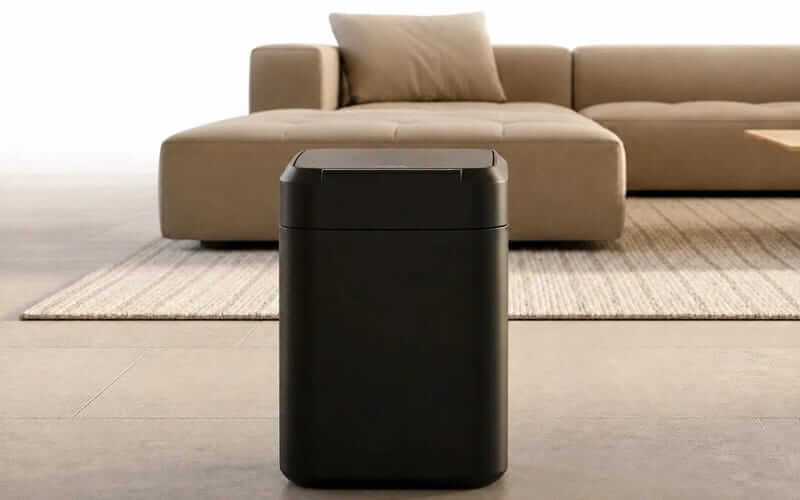
A lid mainly covers the top of the bin. A well-closed bag surrounds the waste itself. Reducing the openings in that bag reduces how readily odor escapes into the bin and the room. Full disclosure: we’re the Trash King® team, and our bins heat-seal each bag shut; whatever bin you use, the useful principle is the same—do not rely on a loose lid or a gathered knot to contain gases produced by an active bag of food waste.
Sealing is not magic, and it does not stop decomposition. It simply gives the odor fewer paths out while the waste is waiting to be removed.
*Written by the Trash King® Team (PR)—we make self-sealing trash cans and write about kitchen hygiene.*
The Trash King® team designs the Royal Bin® line of self-sealing, auto-reloading trash cans (17L, Crown 10L, Ultra 30L), rated 4.9/5 across 353 reviews on trashkingstore.com and backed by a lifetime warranty. We write about kitchen hygiene and smart-home waste.